
Music notation is a crucial tool used by musicians today, and is taught in classroom across the globe. The modern system of notation is robust and nuanced, enabling highly specific instructions to be communicated with ease. But where does music notation come from, and how did it become a standard part of musical practice?
Guido of Arezzo was a music theorist, teacher, and Benedictine monk, born in Italy between 990-1000 CE. At the time, musical performance was an integral part of many Catholic monks’ responsibilities. In his first work, Prologus in antiphonarium, Guido expressed frustration at the amount of time that his peers had to spend learning and rehearsing new music, and set about creating a system that would allow them to spend more time at prayer and study.
After being selected as the musical director in charge of singers at the Arezzo Cathedral, Guido began writing his major work, Micrologus de disciplina artis musicae. Micrologus would soon become the standard manual for teaching singers throughout Italy and later much of Europe. The methods outlined in Micrologus reduced the typical training period for a singer from ten years to only one or two.
Though many of Guido’s innovations are still present in various forms throughout modern music, two of them are particularly recognizable. The first is music notation on a staff composed of lines and spaces, onto which specific notes are placed. This method of notation has gone largely unchanged over time, besides the addition or removal of lines depending on the era.
Another easily recognizable creation is the practice of solmization, where specific pitches (notes) are referred to by syllables. Guido named these syllables “ut-re-mi-fa-sol-la,” referred to collectively as the gamut, which is nearly identical to the modern solfege syllables “do-re-mi-fa-sol-la-ti.” These syllables were very important to his teaching method. Each syllable was mapped to a specific joint on the palm of the hand and fingers, and choir leaders would point to each joint as they taught a new piece of music to aid with memorization.
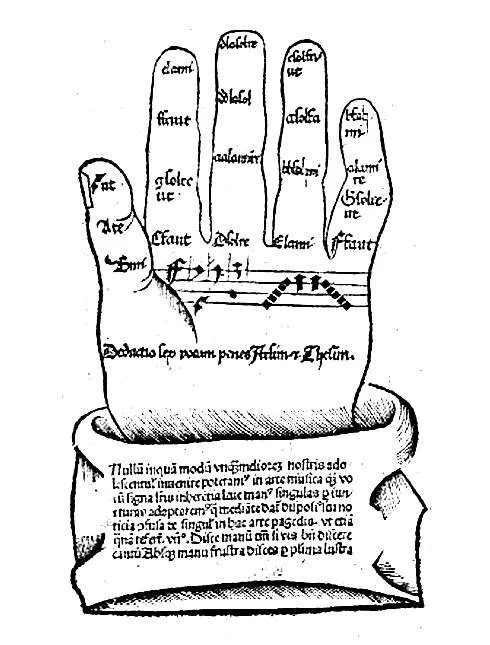
Directly underneath the musical staff lines across the middle of the palm, the text reads:
Latin: Deductio sex vocum per Anselmum et Thelium.
Translation: “The drawing-out (or presentation) of the six voices according to Anselmus and Thelius.”
(Note: This credits the specific theoretical variation of the musical scale system used in this particular woodcut).
The paragraph written on the scroll wrapping around the wrist is a rhyming mnemonic poem meant for young choir students learning music theory:
Latin:
Nullum inquam modum unquam dioceses nostris adolescentes invenire poterant in arte musica qui vos ista figura seu inspectio huius manus singulas per iuncturam edocet distinctam qui mediate dat dispositioni notitia ostendat et singulum in hac arte presidium ut clare ipsa refert. Ut. Disce manum qui vis bene discere cantum: Absque manu frustra disces per plura lustra.
Translation:
“I say that the youths in our dioceses could never find any method in the art of music that teaches you as thoroughly as this drawing or inspection of this hand, which instructs you joint by joint. It clearly offers proper arrangement, knowledge, and every aid in this art, just as it shows itself. Learn the hand if you wish to learn singing well; without the hand, you will learn in vain through many years.”
The words scattered across the fingertips and finger joints are combinations of pitch letters and solfège syllables (the ancestors of Do, Re, Mi) used to navigate the medieval vocal scale:
Letters (A, B, C, D, E, F, G): Indicate the absolute pitch name.
Syllables (Ut, Re, Mi, Fa, Sol, La): Indicate the relative step in the scale. For example, “Alamire” meant the pitch A could serve as La, Mi, or Re depending on which overlapping hexachord the singer was shifting into.
