
The Geometry of Music
Most musical pieces can be represented in geometric form. Most are extremely simple and form the basis of most ‘popular’ music because of their repetitive nature. Some however are somewhat more complex and many of the classic composers use a structure within their music to establish definition and construction. Consider the descending sequences from the first movement of Brahms’ C minor Piano Quartet, Op. 60.
Brahms’ C minor Piano Quartet, Op. 60.
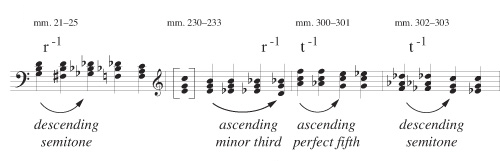
Below is the result of moving downward along the equal-tempered lattice at the centre of chord space. (Major chords are dark spheres, minor chords light spheres.)

There are six basic sequences that can be formed in this way, depending on whether one lowers the root or the third of the initial major triad, and whether the sequence descends by semitone (D1), ascends by seven semitones (A7), or ascends by three semitones (A3). ascends by three semitones (A3).
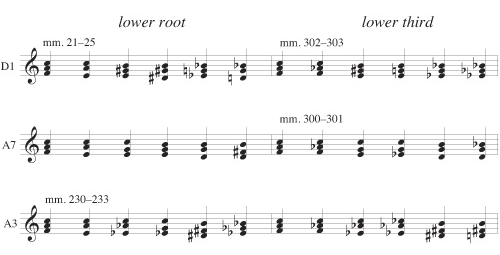
Thus it can be seen that much musical structure can be demonstrated in geometric form. More information can be found in Dmitri Tymoczko’s dissertation here.
